
Shockwave Therapy for Patellar Tendinopathy: Can It Help Jumper’s Knee?
Pain just below your kneecap every time you run, jump, squat, or change direction can quickly turn from a minor annoyance into something that affects your training.
For a runner, it may start after increasing weekly mileage. A soccer player might notice it during sprinting, cutting, or striking the ball. Basketball and volleyball players may feel it when jumping and landing, while someone who strength trains might notice pain during squats, lunges, or other knee-dominant exercises.
One possible cause of this type of pain is patellar tendinopathy, commonly known as “jumper’s knee.”
Patellar tendinopathy can become particularly frustrating when the pain sticks around despite rest, stretching, or other treatments. In chronic cases, extracorporeal shockwave therapy (ESWT) is one treatment that may be considered alongside an appropriate rehabilitation program.
So what exactly is patellar tendinopathy, and where does shockwave therapy fit into treatment?
What Is Patellar Tendinopathy?
The patellar tendon is the strong band of connective tissue that runs from the bottom of your kneecap to your tibia. It plays an important role in the knee extensor mechanism and helps transfer force during activities such as running, jumping, landing, and decelerating.
Patellar tendinopathy is generally considered a load-related tendon disorder. Repeated mechanical demands that exceed the tendon’s current capacity can contribute to changes within the tendon and eventually produce pain and decreased function.
Despite the nickname “jumper’s knee,” you don't have to play a jumping sport to develop it.
It can affect:
Runners
Soccer players
Basketball players
Volleyball players
Weightlifters
CrossFit athletes
Recreational athletes and active adults
Research has consistently associated patellar tendinopathy with sports involving running, jumping, and rapid changes of direction. Training and exercise load also appear to play an important role in its development.
What Does Patellar Tendinopathy Feel Like?
Patellar tendinopathy commonly causes localized pain near the bottom of the kneecap where the patellar tendon attaches.
The pain is often related to loading the tendon.
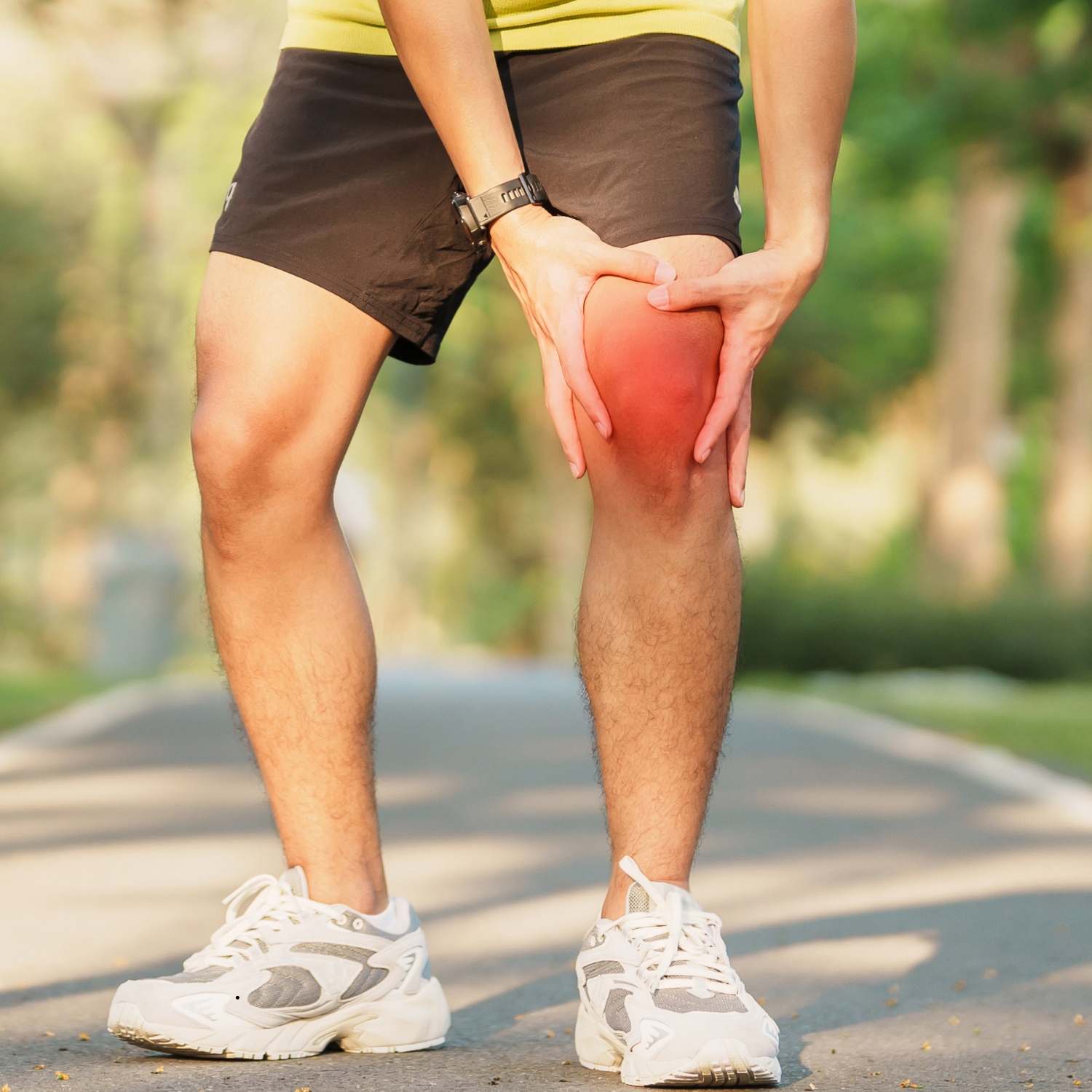
For example, you might feel relatively normal walking around throughout the day but experience pain when you:
Run
Sprint
Jump or land
Squat
Lunge
Climb stairs
Change direction
Perform heavy lower-body exercises
Symptoms can vary depending on the athlete.
A runner may first notice knee pain after increasing mileage or adding hills or speed work. A soccer player may experience symptoms during repeated sprinting and cutting. A basketball or volleyball player might notice pain during takeoff and landing. A lifter may primarily feel symptoms at deeper squat angles or during heavy knee-dominant exercises.
This is one reason identifying the activities and training changes associated with the pain is an important part of evaluating patellar tendon problems.
Why Can Patellar Tendon Pain Become So Stubborn?
Tendons need load.
But they also need enough time and appropriate progression to adapt to that load.
This creates a difficult situation for athletes. Completely resting the knee may temporarily decrease symptoms, but returning immediately to the same training demands that irritated the tendon can cause the pain to return.
On the other hand, repeatedly training through significant tendon pain without adjusting the workload may continue to exceed the tendon’s current capacity.
With chronic patellar tendinopathy, research has identified structural changes within the tendon rather than simply an ongoing inflammatory process. This is one reason the older term “patellar tendinitis” does not accurately describe every case of persistent patellar tendon pain.
Treatment therefore isn't necessarily about eliminating all activity. The goal is often to manage irritating loads while gradually rebuilding the tendon’s ability to tolerate the demands of your sport or activity.

Myth vs. Fact:
❌ Myth: Patellar tendinopathy is simply an inflamed patellar tendon, which is why it's sometimes called “patellar tendinitis.”
✅ Fact: Chronic patellar tendinopathy is more complicated than persistent inflammation. Research examining chronic tendon pathology has found structural and degenerative changes within the tendon, which is why the term tendinopathy is generally preferred for persistent cases.
This distinction matters because treating a chronic tendon problem isn't necessarily about simply “getting rid of inflammation.” Restoring the tendon’s ability to tolerate load is an important part of rehabilitation.
What Is Shockwave Therapy?
Extracorporeal shockwave therapy is a non-invasive treatment that delivers mechanical acoustic energy into targeted tissue.
Despite the name, shockwave therapy does not electrically shock the body.
Instead, mechanical energy is delivered through the skin to the treatment area. Shockwave therapy has been studied for several chronic tendon disorders, including patellar tendinopathy.
Proposed biological effects include mechanotransduction, changes in local cellular signaling, stimulation of vascular responses, and modulation of pain. However, exactly how these biological effects translate into clinical improvement is still an active area of research.
This distinction is important: shockwave therapy isn't simply “breaking up scar tissue.” Its proposed effects are considerably more complex.
Myth vs. Fact:
❌ Myth: Shockwave therapy works by smashing or breaking up scar tissue in the patellar tendon.
✅ Fact: That's an oversimplification of how shockwave therapy is thought to work. Shockwave delivers mechanical energy to tissue, and research suggests that this mechanical stimulation may trigger biological responses through a process known as mechanotransduction.
Proposed effects include changes in cellular signaling, vascular responses, the local healing environment, and pain modulation. In other words, we're not simply trying to “break something up.” We're using mechanical stimulation to influence how the tissue responds.
Can Shockwave Therapy Help Patellar Tendinopathy?
This is where the research gets interesting.
Several studies have reported encouraging outcomes when ESWT has been used for chronic patellar tendinopathy.
Wang et al. (2007)
One of the most commonly cited studies comes from Wang and colleagues.
The researchers compared ESWT with conservative treatment in patients with chronic patellar tendinopathy. The study included 27 patients (30 knees) receiving shockwave therapy and 23 patients (24 knees) in the comparison group.
The shockwave group received a single treatment consisting of 1,500 impulses at an energy flux density equivalent to 0.18 mJ/mm².
At follow-up, the researchers reported better clinical outcomes in the shockwave group. The later review by Leal and colleagues summarized the study as reporting good or excellent outcomes in approximately 90% of the ESWT group compared with 50% of the comparison group at 12 months.
The researchers also reported ultrasound changes involving the proximal patellar tendon.
These findings helped establish some of the early clinical evidence supporting ESWT for chronic patellar tendinopathy.
Vulpiani et al. (2007)
Vulpiani and colleagues followed 73 patients with jumper's knee who had not responded to previous conservative treatment.
Rather than only examining what happened immediately following treatment, this study followed patients over a longer period.
The authors reported improvements in pain and function that continued over time. A later review of the study reported improvement of approximately 43% after one month and 79% at 24 months.
Because this was an observational study rather than a randomized placebo-controlled trial, it cannot establish that shockwave alone caused those improvements. However, the longer follow-up provides useful information about outcomes in patients with persistent patellar tendon problems.
Zwerver et al. (2010)
Zwerver and colleagues investigated patient-guided piezoelectric ESWT in athletes with chronic, severe patellar tendinopathy.
The study was small, involving 19 high-level athletes, so its findings should be interpreted as preliminary rather than definitive.
Still, the results were encouraging enough for the authors to describe ESWT as a promising treatment option for chronic severe patellar tendinopathy.
Taken together, these studies suggest that shockwave therapy may be beneficial in some patients with chronic patellar tendinopathy, particularly when symptoms have persisted despite previous conservative care.
But that's not the entire research story.
Does Shockwave Therapy Work for Everyone?
No treatment works for every case of patellar tendinopathy, and research on shockwave therapy has produced mixed results.
A randomized clinical trial published by Zwerver and colleagues in 2011 studied actively competing volleyball, basketball, and handball athletes with patellar tendinopathy lasting between three and 12 months.
Athletes received either three ESWT treatments or sham shockwave therapy while continuing to participate during their competitive season.
Both groups improved over time, but there was no significant difference in VISA-P scores between ESWT and placebo. The researchers concluded that ESWT used as a solitary treatment during the competitive season did not provide additional benefit in this particular population.
That finding gives us an important piece of the puzzle.
The question may not simply be:
“Does shockwave work for patellar tendinopathy?”
A better question may be:
“Which patients are most likely to benefit from shockwave, and what else is being done to address the tendon’s ability to tolerate load?”
Myth vs. Fact:
❌ Myth: If shockwave therapy decreases my knee pain, I don't need to strengthen or rehabilitate the tendon.
✅ Fact: Shockwave therapy should not be viewed as a replacement for rehabilitation. Patellar tendinopathy is a load-related condition, so improving the tendon’s ability to tolerate the demands of running, jumping, lifting, or playing your sport remains an important part of recovery.
Shockwave may be a useful adjunct in certain cases, particularly with chronic symptoms, but it should be incorporated into a broader treatment plan that addresses loading and rehabilitation.
Shockwave Shouldn't Replace Rehabilitation
This may be the most important point in this entire article.
Shockwave therapy should not be viewed as a replacement for progressive rehabilitation.
Exercise-based loading has some of the strongest evidence supporting conservative management of patellar tendinopathy.
A 2021 randomized clinical trial involving 76 patients with mostly chronic patellar tendinopathy compared progressive tendon-loading exercise with traditional pain-provoking eccentric exercise. After 24 weeks, the progressive tendon-loading group demonstrated significantly greater improvement in VISA-P scores.
The researchers recommended progressive tendon-loading exercise as an initial conservative treatment for patellar tendinopathy.
A review of shockwave therapy for chronic patellar tendinopathy similarly concluded that ESWT should be viewed as part of a treatment protocol rather than an isolated treatment, with rehabilitation and progressive loading playing important roles.
In practice, this means shockwave may be used as an adjunct to rehabilitation, rather than the entire rehabilitation plan.
What Might Rehabilitation Look Like?
There isn't one exercise program that works for every athlete.
The appropriate progression depends on factors such as symptoms, current strength, training demands, sport, and the amount of load the tendon can currently tolerate.
A rehabilitation program may progress through different forms of quadriceps and tendon loading before eventually reintroducing higher-demand activities.
For a runner, that eventually means tolerating repeated running loads.
For a soccer player, it may mean progressing toward sprinting, deceleration, cutting, and kicking.
For a basketball or volleyball player, jumping and landing capacity becomes important.
For a weightlifter, the goal may be returning to progressively heavier squats, lunges, and other knee-dominant movements.
The end goal isn't simply to make the tendon feel better while you're sitting in the clinic.
The goal is to prepare it for what you actually want to do.
Do You Have to Stop Playing Your Sport?
Not necessarily.
Activity modification does not always mean complete rest.
The appropriate amount of training depends on symptom severity, the stage of the condition, and how the tendon responds to loading.
For one athlete, temporarily reducing running mileage may be enough. Another may need to decrease jumping volume. A soccer player may need to modify the number of high-intensity practices or sprints, while a lifter may temporarily adjust squat depth, load, volume, or exercise selection.
The goal is to find an amount of activity the tendon can tolerate while progressively increasing its capacity over time.
This is also one possible explanation for why treatment results can differ between studies. In the 2011 Zwerver trial, athletes continued competing during the season and shockwave was used as a solitary intervention. Those results shouldn't automatically be applied to every person with chronic patellar tendinopathy, but they demonstrate why the athlete's overall loading environment matters.
Is Shockwave Therapy Right for Your Patellar Tendon Pain?
Not every case of pain at the front of the knee is patellar tendinopathy.
Other structures and conditions can produce similar symptoms, which is why an appropriate evaluation should come before treatment.
If your symptoms are consistent with patellar tendinopathy, treatment should consider more than just where it hurts. Your training history, recent changes in activity, strength, movement demands, sport, symptom duration, and previous treatments can all help determine an appropriate plan.
For chronic cases, shockwave therapy may be one useful component of that plan.
But the research also gives us a reason to avoid thinking of shockwave as a magic fix.
The strongest approach is often a combination of appropriate load management, progressive rehabilitation, and adjunctive treatments when indicated.
What we do at sideick Chiropractic for Patellar Tendinopathy
At Sidekick Chiropractic, we work with athletes and active adults dealing with sports injuries and persistent musculoskeletal pain.
If pain around your patellar tendon is keeping you from running, playing soccer, jumping, lifting, or participating in the activities you enjoy, the first step is figuring out what is actually contributing to the problem.
From there, we can develop a treatment plan based on your specific goals and determine whether shockwave therapy and progressive rehabilitation may be appropriate for you.
Don't just treat where it hurts. Understand why it hurts and build a plan to get back to what you want to do.
Final Thoughts
Patellar tendinopathy can be frustrating, especially when you feel like you've already tried resting, stretching, or modifying your workouts and the pain keeps coming back.
The biggest thing I want people to understand is that there usually isn't one magic treatment that fixes everything. Shockwave therapy can be a great tool for chronic patellar tendon pain, but I don't look at it as a replacement for strengthening and rehab. The goal is to use shockwave therapy when appropriate while also building the tendon back up so it can handle the things you actually want to do.
And that looks different for everyone. A runner needs to be able to tolerate miles again. A soccer player needs to sprint, cut, and change direction. A basketball player needs to jump and land. Someone who loves lifting needs to be able to squat without constantly worrying about their knee.
That's why I always want to start by figuring out what's actually causing your pain and what your body is having trouble tolerating. From there, we can create a plan that makes sense for you instead of just chasing the pain.
At the end of the day, the goal isn't just to get your knee feeling better for a few days. It's to get you back to doing the things you enjoy with confidence.